Torque Ripple Across Commutation Methods
Every commutation scheme covered so far is solving the same problem: keep torque pointed in a useful direction as the rotor spins underneath it. But pointing the right way isn't the same as staying the same size, even a scheme that never pushes backward can still push harder at some instants than others, and that wobble in torque, not direction, is called torque ripple.
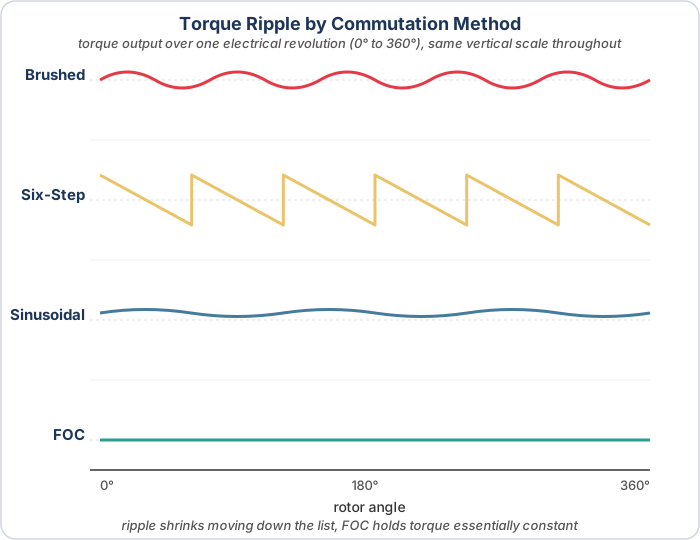
Brushed: Ripple From Segment Count
A brushed motor's commutator only flips current at specific points around the rotation, keyed to however many segments the commutator has. Between those switching points, the torque produced by the motor effect still depends on how well a given coil happens to be aligned with the stator's field at that instant, so torque drifts up and down through each segment's span rather than holding still. More segments mean more, smaller wobbles instead of fewer, larger ones, which is exactly why real brushed motors wind many coils onto many commutator segments instead of just one.
Six-Step: Ripple From 60° Jumps
Trapezoidal commutation replaces the commutator with six discrete switching states, each covering 60° of rotation. Inside a single step, the two energized phases stay fixed while the rotor keeps turning underneath them, so the angle between the stator's push and the rotor's magnet drifts away from the ideal 90° for most of the step, passing through it only once, then a hard jump resets the field back to a fresh 60°-early position at the next step. That combination, drift then jump, is what produces the sharp, sawtooth-shaped ripple that gives six-step commutation its characteristic whine and vibration.
Sinusoidal: Smoother, But Still Open-Loop
Driving each phase as a smooth sine wave removes the jumps entirely, the field sweeps continuously instead of hopping, so the ripple that's left is much smaller. But sinusoidal commutation on its own is still open-loop: the controller traces out a sine wave it assumes matches the real current, without ever measuring and correcting the actual current amplitude. Winding resistance, inductance, and back-EMF all shift the real current slightly away from that assumption as speed and load change, leaving a small residual ripple sinusoidal commutation has no way to notice, let alone fix.
FOC: Ripple Suppressed by Closed-Loop Correction
FOC keeps the same smooth sine waves sinusoidal commutation uses, but stops assuming they're correct. By transforming the currents into the rotor's own / frame, a properly commutated motor's torque-producing current collapses into a single steady number, , that a PI loop can measure and correct thousands of times per second. Any ripple that would have crept in from resistance, inductance, or back-EMF gets corrected away almost as soon as it appears, which is why FOC is the only method on this page that holds torque essentially flat.
See Comparing the Approaches for how ripple stacks up against the other tradeoffs, wiring complexity and position feedback needed, between all four methods.