💡 Open Loop Control
Robot code's most basic job is turning a desire, "spin this flywheel," "hold this arm level," into an electrical command sent to a motor. This section is about how that command actually gets decided, starting with the simplest possible approach: open loop control, sending a command and never checking whether it worked.
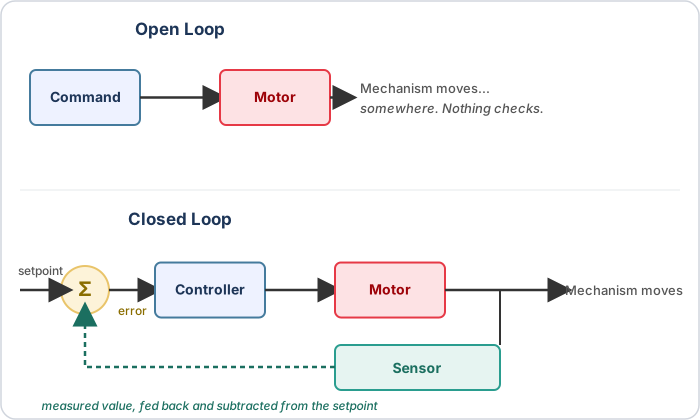
An open loop system has no feedback path, the command goes out, the motor does whatever that command and the physical world produce, and the code moves on without ever looking back to see what actually happened. A closed loop system (covered in the next part of this section) adds a sensor and compares what actually happened to what was wanted, correcting the difference. Open loop is simpler, cheaper, and often good enough, but only when the relationship between "command sent" and "result produced" is predictable enough to trust blind.
This part of the Controls section covers three ideas, in order:
- Percent Output and Duty Cycle Control, the crudest, most direct way to command a motor.
- Voltage Control, fixing percent output's biggest flaw: it isn't actually consistent.
- Feedforward Models, predicting the exact voltage a mechanism will need before it ever moves, using the same physics Motors and Commutation covers in full later on.
- Comparing Open Loop Methods, when open loop is enough, and where it starts to fall short.
Open loop control isn't a lesser version of closed loop control, it's the right tool whenever a mechanism's behavior is predictable enough that guessing correctly (with good math) beats measuring and correcting. A flywheel spinning up to a known speed, or a drivetrain being driven by a human, are both often handled perfectly well without any feedback at all.