SPI: Serial Peripheral Interface
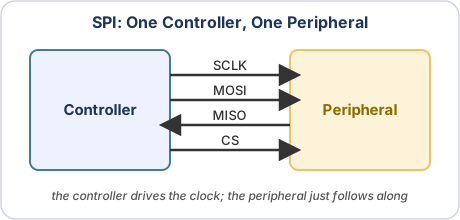
SPI (Serial Peripheral Interface) fixes UART's "agree on a speed in advance" problem by adding a dedicated clock wire, making it synchronous: the controlling device (the controller) toggles a clock line (SCLK), and every other device (a peripheral) reads or writes exactly one bit on every clock tick, so there's never any ambiguity about timing. A basic SPI link uses four wires: SCLK (clock), MOSI (Controller Out, Peripheral In), MISO (Controller In, Peripheral Out), and CS (Chip Select).
For more details and specifics, see here
How a Bit Is Actually Transferred: Clock Edges
Every clock cycle has two edges, one where SCLK switches away from its resting level, and one where it switches back. SPI splits the job of moving one bit between those two edges: on one edge a device shifts its next bit onto MOSI or MISO, and on the other edge the receiving device samples whatever voltage is sitting on the wire at that instant. Two settings decide exactly which edge does which job. Clock polarity (CPOL) picks which voltage the clock rests at between bits, low or high. Clock phase (CPHA) picks whether a bit is sampled on the first edge of each cycle (with the next bit shifted out on the second edge) or shifted out on the first edge and sampled on the second. Both devices on the link have to agree on both settings, since a bit sampled on the wrong edge is just a guess at whatever the line happened to be doing at that instant.

Source: Wikimedia Commons
Talking to Multiple Peripherals
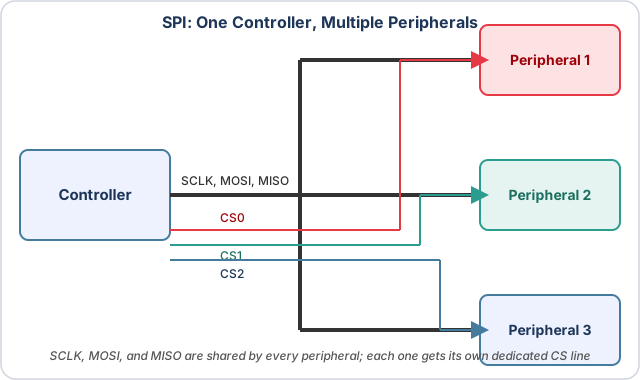
Because SCLK, MOSI, and MISO can all be shared, adding more devices is cheap: give each one its own CS wire, and the controller simply pulls a device's CS line low right before talking to it, so only that one device listens while the others ignore the bus entirely.
Speed
SPI has no single fixed maximum speed the way UART has a baud rate, since a bit moves on every clock edge, the practical ceiling just comes down to how fast a given controller, peripheral, and set of wires can all reliably switch, commonly anywhere from a few megahertz up into the tens of megahertz. The roboRIO's onboard SPI port can talk to up to four peripherals at once (one per CS line), and its MXP expansion port adds an independent clock and data lines plus an additional CS, for teams that need to wire up more than that.
SPI is fast and simple to implement, which is why it's a common choice for onboard sensors that need to be read quickly and often, like gyroscopes.
I2C makes the opposite trade: fewer wires, at the cost of speed.