Trapezoidal Profiles
The simplest motion profile is shaped exactly like its name: plot the velocity a mechanism should be commanded to move at over time, and it traces a trapezoid.
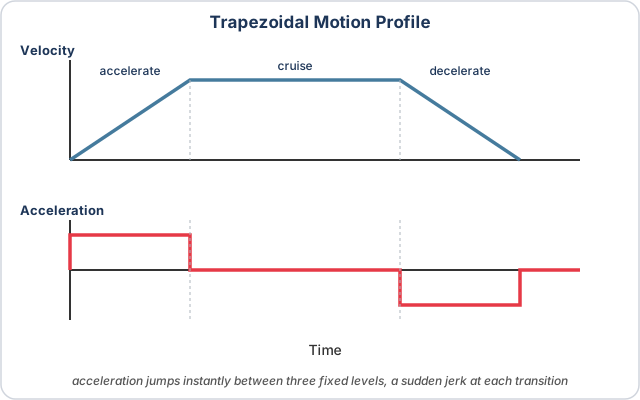
Three Phases
- Accelerate, ramping velocity up from zero at some fixed, chosen acceleration, as fast as the mechanism can safely go.
- Cruise, holding a constant maximum velocity once it's reached, the flat top of the trapezoid.
- Decelerate, ramping velocity back down to zero at the same fixed acceleration, timed so the mechanism arrives exactly at its target position the instant velocity reaches zero.
Every instant along that trapezoid produces a matching position setpoint too (position is just the running total of velocity over time), so a controller following a trapezoidal profile is really tracking a constantly advancing position target, never a single distant one.
Two Numbers Define the Whole Shape
A trapezoidal profile only needs two limits to be fully specified: a maximum velocity (the height of the flat top) and a maximum acceleration (how steep the ramps up and down are). Given a starting position, an ending position, and those two limits, the entire trapezoid, how long to accelerate, how long to cruise, when to start decelerating, follows automatically from the same distance/rate/time relationships as any constant-acceleration motion.
Short moves never reach the cruise phase at all. If the distance is too short to hit maximum velocity before needing to decelerate again, the profile becomes a triangle instead, ramping up and immediately back down. The math is the same either way, the cruise phase simply shrinks to zero.
What's Still Missing
Look closely at the acceleration plot above: it jumps instantly between three fixed levels, positive, zero, negative, at each phase change. That's a sudden, discontinuous jerk on the mechanism at every transition, physically unrealistic (nothing can actually change its acceleration in zero time) and hard on gearboxes, belts, and any game piece being carried along for the ride. Smoothing out exactly that jump is what S-Curve Profiles exist to do.