S-Curve Profiles
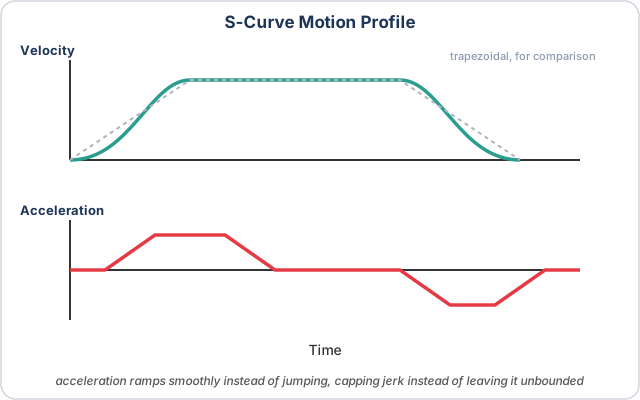
A trapezoidal profile keeps velocity smooth, but its acceleration jumps instantly between fixed levels at every phase change, positive, zero, negative, with nothing in between. An S-curve profile fixes that by applying the exact same trapezoid idea one level deeper: instead of let acceleration jump, ramp acceleration itself smoothly too.
Jerk: the Rate of Change of Acceleration
The rate at which acceleration itself changes has its own name, jerk. A trapezoidal profile has, in effect, infinite jerk at each transition, acceleration changes by a large amount in zero time. An S-curve profile adds a maximum jerk limit, the same way a trapezoidal profile limits maximum acceleration, and the result is an acceleration curve that ramps smoothly up to its peak, holds briefly, and ramps back down, rather than snapping there instantly. Integrate that smoother acceleration once, and velocity gets the same gentle, rounded-off corners visible in the chart above, instead of the trapezoid's sharp ones.
Why Bother
Jerk is what a rider actually feels as sudden and uncomfortable, and what a mechanism feels as a sudden shock load. Limiting it has real, practical payoffs:
- Less mechanical stress. Chains, belts, and gearboxes see a gentler ramp-up in force rather than a sudden snap, meaning less wear over a season of matches.
- Better game piece control. A manipulator carrying something loosely held (a game piece resting in an intake, balanced on a mechanism) is far more likely to keep it in place through a smooth acceleration change than an abrupt one.
- Less voltage overshoot demanded of the motor. A feedforward model's term scales directly with commanded acceleration, a sudden jump in acceleration means a sudden jump in demanded voltage and current, exactly what a jerk-limited profile avoids asking for.
The Cost
An S-curve profile takes slightly longer to complete than a trapezoidal one covering the same distance with the same velocity and acceleration limits, since time is spent easing into and out of the peak acceleration instead of snapping straight to it. It's also a little more work to generate, one more limit to choose, one more layer of integration to compute, though modern FRC libraries handle that computation automatically. In practice, that small time cost is almost always worth it for anything carrying a game piece or driving a mechanism people will feel.
Continue to Feedforward and Motion Profiles Together to see how either profile shape feeds directly into the feedforward models from earlier in this section.