Proportional Control (P)
The simplest possible rule for turning error into a motor command is: push harder the more wrong things currently are. That's proportional control, and it's exactly what it sounds like, the commanded output is just the error multiplied by a constant, the proportional gain :
The Intuition: A Spring
Proportional control behaves a lot like an actual physical spring stretched between where the mechanism is and where it's supposed to be. Far from the setpoint, the "spring" is stretched a long way and pulls hard; close to the setpoint, it barely pulls at all. That's why a mechanism under pure P control slows down as it approaches its target, the very thing driving it forward (the error) is shrinking the whole time.
The Gain Tradeoff
controls how stiff that spring is, and every proportional controller has to balance the same two failure modes:
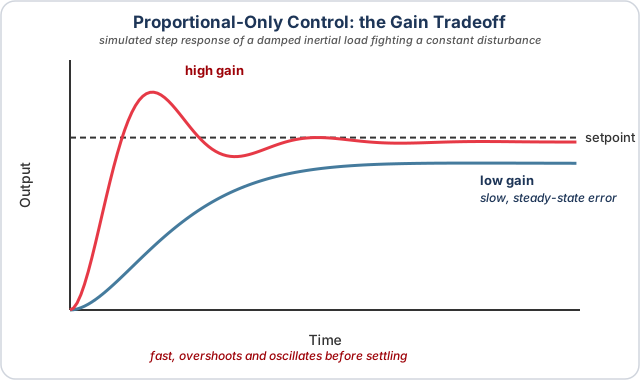
- Too low, and the "spring" is weak. The mechanism creeps toward the setpoint slowly, and worse, it typically never quite arrives, see Steady-State Error below.
- Too high, and the "spring" is so stiff that the mechanism blows straight past the setpoint (since it's still moving fast right as the error crosses zero), then gets pulled back the other way, overshooting again, and again, oscillating for a while before it finally settles.
Somewhere between those extremes is a gain that's fast without oscillating badly, and finding that value is the subject of PID Tuning.
The Error P Alone Can't Fix
Pure proportional control almost always settles slightly short of the actual setpoint, called steady-state error. The reason is built into the formula itself: the output only produces a nonzero command when the error is nonzero. If a mechanism needs some ongoing output just to hold its position, an arm resisting gravity, a drivetrain wheel fighting friction, that output can only come from a small, permanent, leftover error, since a P controller can't be persuaded to keep pushing once the error hits exactly zero. Erasing that leftover error without needing a nonzero error to sustain it is exactly the job of Integral Control.