Integral Control (I)
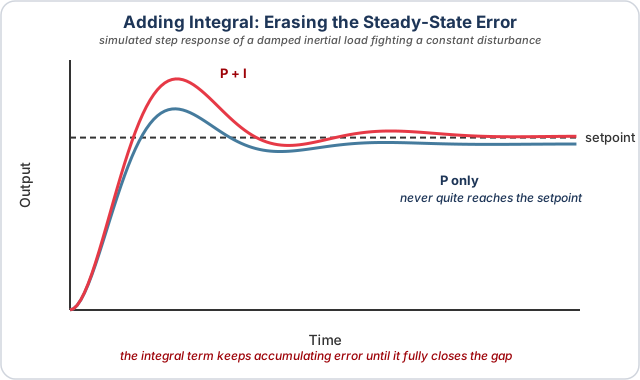
Proportional control almost always leaves a small, permanent steady-state error behind, since its output shrinks to zero exactly when the error does, even if the mechanism still needs some ongoing push to stay put. Integral control fixes this by keeping score.
The Intuition: A Running Total
Instead of reacting only to the current error, an integral term keeps a running total of every bit of error that has ever existed, added up over time:
As long as any error persists, even a tiny one, that running total keeps growing, and so does the integral term's contribution to the output. It only stops growing once the error hits exactly zero. That's the key difference from proportional control: P produces a nonzero output only when the error is nonzero, but I can produce a nonzero output even after the error reaches zero, because it remembers everything that came before. That's exactly the "free" ongoing push proportional control could never supply on its own.
The Cost: Overshoot and Wind-Up
Integral control doesn't come for free. Because it's built from accumulated history, it has a kind of memory or momentum, and that history keeps pushing even after the error has crossed zero and started going the other way, which is exactly why a P+I controller commonly overshoots a little before settling, visible in the chart above.
Push this too far and a more serious problem shows up, called integral windup: if a mechanism is physically stuck (an arm jammed against a hard stop, a wheel that can't spin fast enough to keep up), the error stays large for a long time, and the integral term keeps accumulating the whole time, growing far larger than it should. The moment the mechanism frees up, that oversized accumulated value slams the output hard in the other direction, a sudden, often dangerous overshoot. Most real controllers guard against this by clamping the integral term to some maximum value, so it can never accumulate an unreasonably large correction no matter how long an error persists.
When to Reach for It
Integral control earns its complexity specifically when a mechanism needs a sustained, nonzero output just to hold still, exactly the gravity-fighting and friction-fighting situations feedforward's and terms were built for. In practice, a good feedforward model often shrinks how much integral gain is even needed, since feedforward is already supplying most of that steady push before the loop has to accumulate anything to make up the difference. Damping the overshoot integral control tends to introduce is the job of Derivative Control.