🔍 Vision Processing
A raw camera frame is just a grid of pixel brightness and color values, nothing in it is labeled "target." Vision processing is the pipeline that turns that raw grid into something robot code can act on: where a target is, and, for the AprilTags most modern FRC vision relies on, exactly where the camera is relative to it. FRC has used two fundamentally different kinds of targets over the years, and they're worth contrasting because they push the pipeline in very different directions.
Retroreflective Targets: Finding a Blob
Older FRC games marked targets with retroreflective tape, material that bounces light directly back toward its source rather than scattering it. Pairing that tape with a ring of bright LEDs mounted around the camera lens makes the target light up dramatically brighter than everything else in frame, so much so that lowering the camera's exposure until only the tape is visible is itself a common processing trick:
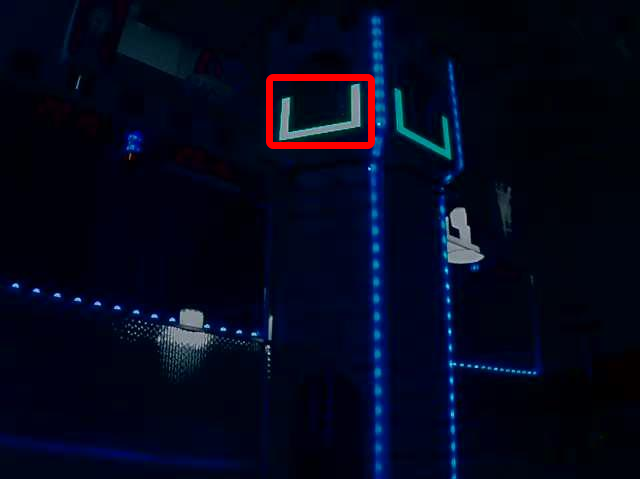
Source: WPILib Docs
From there, the pipeline's job is comparatively simple: threshold the image (keep only pixels above a brightness cutoff), find the resulting blob's contour, and compute its centroid. Combined with the camera's intrinsics from Hardware, that centroid converts directly into a horizontal and vertical angle from the camera's lens to the target, enough to steer toward it, but nothing about distance or orientation without extra geometric assumptions (like knowing the target's fixed height off the floor).
AprilTags: Finding a Pose, Not Just a Blob
Landmarks & AprilTags covers what an AprilTag physically is and why FRC uses them as landmarks; what matters here is what the pipeline actually does with one. Unlike a plain reflective blob, an AprilTag's pipeline can identify a detected square's four corners with pixel-level precision, along with the ID encoded in its grid of cells:
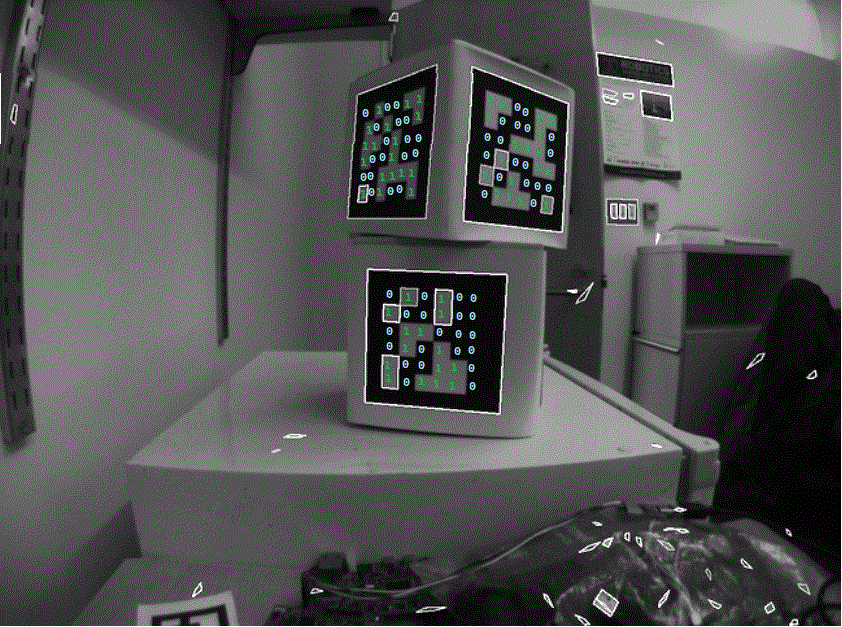
Source: WPILib Docs
Because the tag's physical size and the geometry of its corners (in the tag's own frame, from Coordinate Frames) are known exactly, along with the camera's intrinsics, that's enough information to solve for the camera's full pose relative to the tag, not just an angle.
That calculation is an instance of the classic Perspective-n-Point (PnP) problem: given several 3D points in a
known local frame (a tag's four corners) and where those same points landed in the 2D image, solve for the 3D pose
that would have produced exactly that projection. The output is a Transform3d describing the tag's position and
orientation relative to the camera (or equivalently, the camera relative to the tag).
Ambiguity
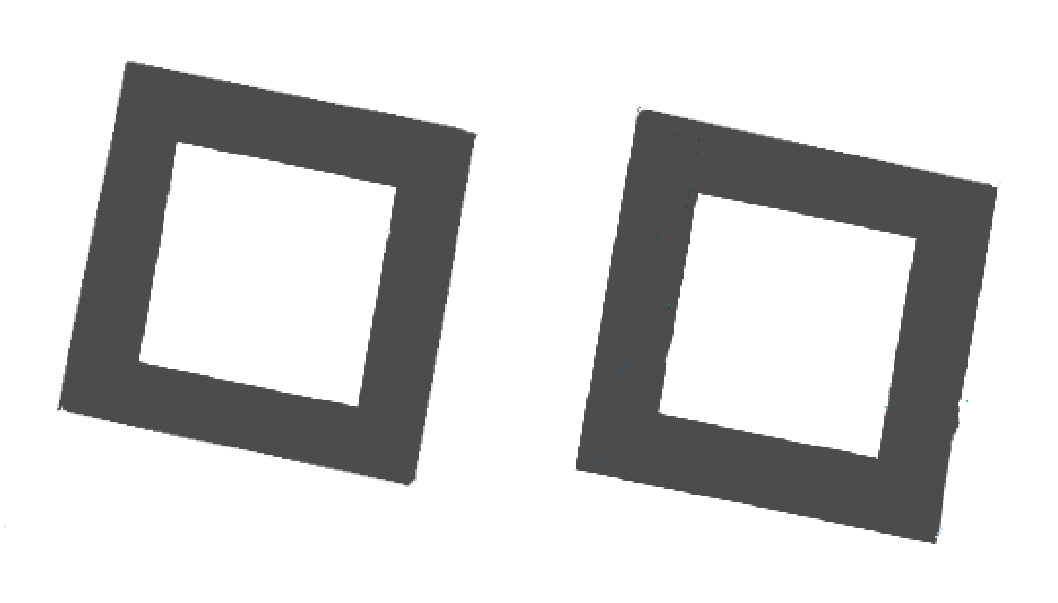
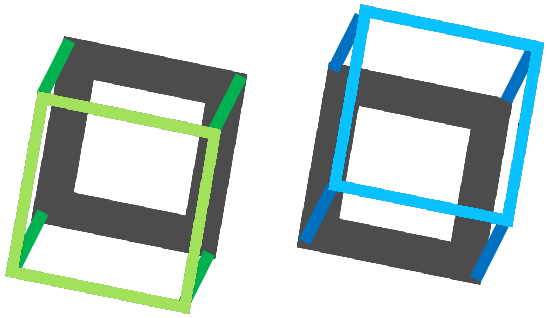
A flat, square target viewed at certain angles has a subtle problem: two meaningfully different poses can produce almost the same 2D projection, especially when the tag is viewed nearly head-on:
Source: WPILib Docs
Translating the four known corners of a target in a two-dimensional image back into a three-dimensional real-world position is inherently ambiguous this way: there are multiple real-world poses that land those same four corners in almost the same spot in the image. A human can often resolve this instinctively from lighting or background context, but a detector has no such context to lean on. The PnP solver can return either pose, and a small amount of pixel noise is enough to flip which one it picks between frames, a phenomenon vision pipelines like PhotonVision report as an ambiguity score. Code consuming single-tag pose data generally has to either reject high-ambiguity detections outright or lean on multi-tag PnP, solving simultaneously for a pose that's consistent with every tag visible in frame at once, which resolves the ambiguity almost entirely because it's extremely unlikely for the wrong pose to satisfy multiple tags at different positions simultaneously.
From "Relative to the Camera" to "On the Field"
Everything covered so far only produces a target's pose relative to the camera, useful, but not yet the thing the robot actually needs: its own pose in the field frame. Getting there means chaining this camera-relative measurement together with the tag's known field position and the camera's known mounting position on the robot, exactly the kind of pose-and-transform composition introduced in Coordinate Frames, which is where Pose Estimation picks up.