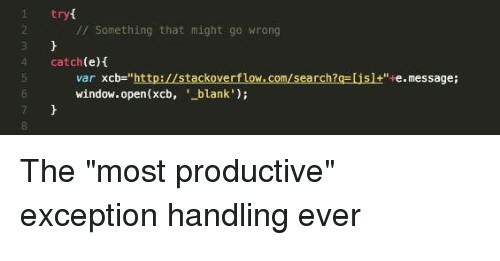
Exceptions
An exception is an object that represents an error or unexpected event that disrupts
the normal flow of a program. You've already run into a few of these throughout this
guide, such as the ClassCastException mentioned in the Type Casting section. Rather
than letting these errors crash the entire robot program, Java gives you tools to
detect and respond to them gracefully.
Try, Catch, and Finally
The try block contains code that might throw an exception. If an exception occurs,
execution immediately jumps to the matching catch block instead of crashing the
program.
Try-Catch Formula
try {
    [risky code]
} catch ([ExceptionType] [name]) {
    [code that runs if the exception occurs]
}
try {
    int result = 10 / 0; // Throws an ArithmeticException
    System.out.println("This line never runs");
} catch (ArithmeticException e) {
    System.out.println("Cannot divide by zero!");
}
Output:
Cannot divide by zero!
Finally
An optional finally block can be added after the catch block. Code inside
finally always runs, whether or not an exception was thrown, making it useful for
cleanup work like closing a sensor connection.
try {
    int result = 10 / 0;
} catch (ArithmeticException e) {
    System.out.println("Cannot divide by zero!");
} finally {
    System.out.println("This always runs");
}
Catching Multiple Exception Types
A single try block can be followed by multiple catch blocks, allowing different
exception types to be handled differently. Java also allows multiple types to be
caught in one block using |.
try {
    riskyMethod();
} catch (ArithmeticException e) {
    System.out.println("Math error");
} catch (NullPointerException e) {
    System.out.println("Something was null");
}
try {
    riskyMethod();
} catch (ArithmeticException | NullPointerException e) {
    System.out.println("Something went wrong");
}
Checked vs. Unchecked Exceptions
Java splits exceptions into two categories:
- Checked Exceptions: Must either be caught or declared. The compiler forces you
to acknowledge these could happen. Example:
IOException - Unchecked Exceptions: Don't need to be caught or declared. These usually
represent programming mistakes, such as
ArithmeticException,NullPointerException, andClassCastException
Throwing Exceptions
The throw keyword is used to manually trigger an exception when something goes
wrong in your own code.
if (voltage > 12) {
    throw new IllegalArgumentException("Voltage cannot exceed 12");
}
If a method doesn't handle a checked exception itself, it must declare that it might
throw one using the throws keyword in its method signature. For more information
about methods, see the Object-Oriented Programming section.
public void readSensor() throws IOException {
    // Code that might throw an IOException
}
Custom Exceptions
Just like any other class, you can create your own exception types by extending
Exception (checked) or RuntimeException (unchecked). This is useful for giving
teammates a more descriptive error than a generic Java exception.
public class SensorDisconnectedException extends RuntimeException {
    public SensorDisconnectedException(String message) {
        super(message);
    }
}
if (!sensor.isConnected()) {
    throw new SensorDisconnectedException("Encoder disconnected on the elevator");
}
For more information about extends and inheritance, see the Object-Oriented
Programming section.