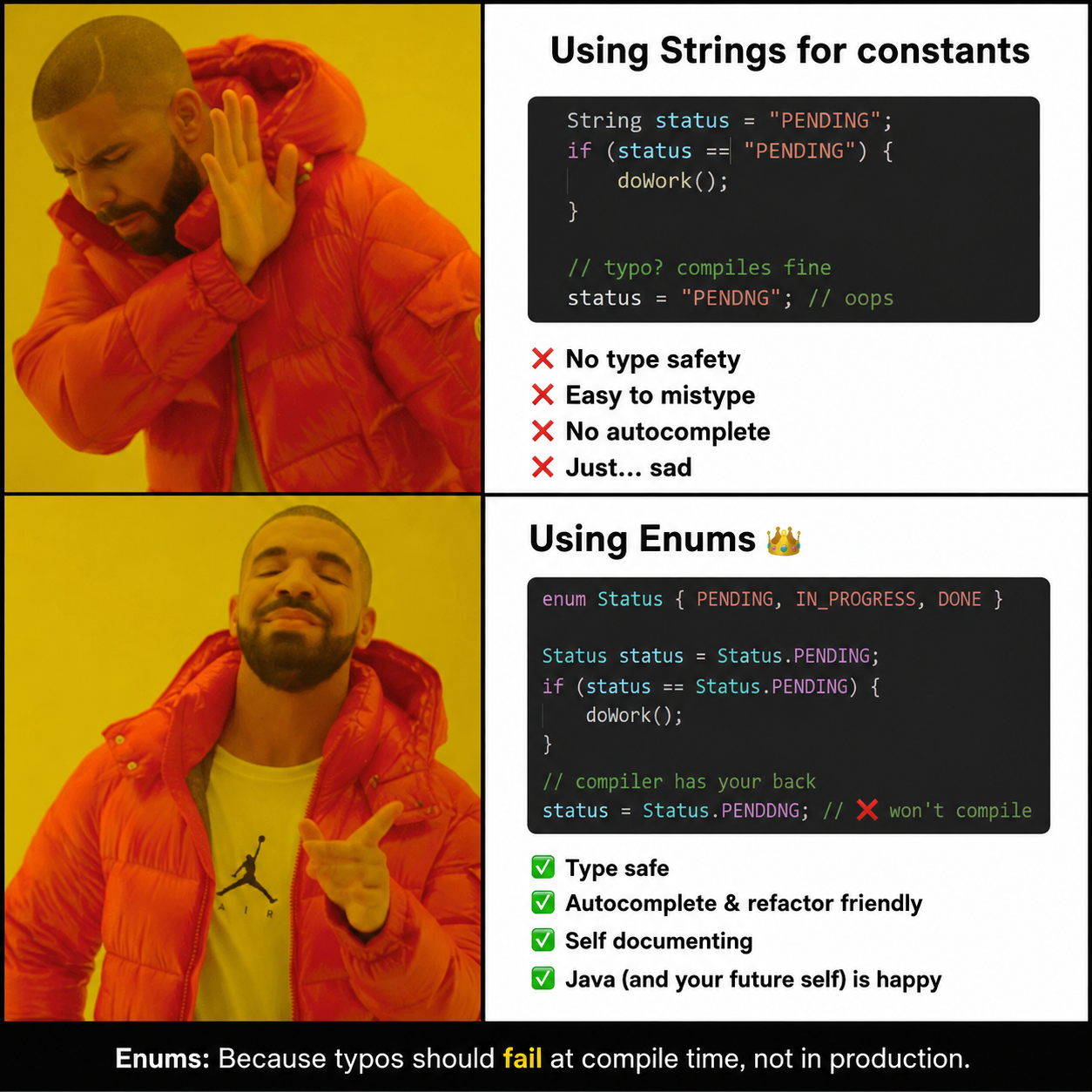
Enums
An enum (short for enumeration) is a special data type that represents a fixed set of named constants. Enums are useful whenever a variable should only ever hold one of a small, known set of values, such as the state of a robot mechanism.
Declaring an Enum
Enum Formula
enum [EnumName] {
    [CONSTANT_ONE], [CONSTANT_TWO], [CONSTANT_THREE]
}
enum ElevatorState {
    STOWED, INTAKING, SCORING
}
An enum is created much like any other class, and its constants are accessed using the enum name followed by the constant.
ElevatorState currentState = ElevatorState.STOWED;
Unlike a plain int or String, an ElevatorState variable can only ever be one of
the three declared constants, so a typo like ElevatorState.STOWD is a compile error
instead of a silent bug.
Enums in a Switch Statement
Enums pair especially well with switch statements, since the compiler already knows every possible value the variable could hold. For more information about switch statements, see the Switch section.
Show code
switch (currentState) {
    case STOWED:
        elevator.setVoltage(0);
        break;
    case INTAKING:
        elevator.setVoltage(-2);
        break;
    case SCORING:
        elevator.setVoltage(6);
        break;
}
Enums with Fields and Constructors
Enums aren't limited to just being a list of names, they can also carry their own data, just like a regular class. Each constant calls the enum's constructor when it's declared.
Show code
enum ElevatorState {
    STOWED(0),
    INTAKING(-2),
    SCORING(6);

    private final double voltage;

    ElevatorState(double voltage) {
        this.voltage = voltage;
    }

    public double getVoltage() {
        return voltage;
    }
}
double voltage = ElevatorState.SCORING.getVoltage(); // Equal to 6
This pattern is extremely common in FRC robot code, since it lets you bundle a
mechanism's named states directly together with the values (voltages, setpoints,
timeouts) associated with each one, instead of managing them as separate variables.
For more information about fields, constructors, and the this keyword, see the
Object-Oriented Programming section.